Jensen Huang
What Jensen Huang, Nvidia's co-founder and only CEO, has actually said and done: the near-death bets (Sega, the RIVA 128, CUDA), "zero-billion-dollar markets", a flat organization with about 60 direct reports and no one-on-ones, "speed of light" planning, and the "pain and suffering" line, each checked against transcripts and dated reporting. The reasoning method has its own sheet, first principles; conventional management practice is on management; the build pipeline is idea to MVP. Compare with Elon Musk, Steve Jobs and the shorter entries on other founders.
Who he is and why listen
| Fact | Detail | Source |
|---|---|---|
| born | 17 February 1963, Taipei, Taiwan; the family moved to Tainan, then to Thailand when he was about five. Tainan is often given as his birthplace; the two biographies say Taipei | Wikipedia (citing Kim 2024, Witt 2025) |
| childhood | sent to the US at nine (1973) with his older brother; an uncle enrolled them at the Oneida Baptist Institute in Kentucky, a religious reform academy he mistook for a prestigious boarding school | New Yorker (Witt, 2023) |
| first job | from age 15 at a Denny's in Oregon: dishwasher, then busboy, then waiter | his own account, Stanford GSB 2024 and Stripe Sessions 2024 |
| education | BS electrical engineering, Oregon State University (1984); MS electrical engineering, Stanford (1992), studied while working | Oregon State; Stanford GSB |
| before Nvidia | microprocessor designer at AMD, then LSI Logic, where he ran the CoreWare division and worked with Sun engineers Chris Malachowsky and Curtis Priem | Wikipedia; Acquired 2023 |
| Nvidia | co-founded with Chris Malachowsky and Curtis Priem; the three planned it in late 1992 at a Denny's on Berryessa Road, East San Jose; incorporated 5 April 1993; CEO from day one, at 30 | Nvidia; New Yorker; Wikipedia |
| scale (Sept 2026) | fiscal 2026 revenue $215.9bn; first company to close above $4 trillion (10 July 2025) and to reach $5 trillion (29 October 2025) | Nvidia 10-K (FY2026); Washington Post; Reuters |
Why listen: he has run the same company for 33 years, through at least two near-bankruptcies and a decade in which its main strategic bet (CUDA) cost margin with no market to show for it, and the bet then became the foundation of the AI industry. Few founders have explained their operating system in as much detail, on the record. Why be careful: the story is told backwards from the most spectacular timing win in tech history. Much of it worked because deep learning happened to need exactly what Nvidia had built, and some of his habits (public criticism, 60 direct reports, seven-day weeks) are documented as hard on the people around him.
Quotation note: Huang says most things many times in slightly different words, and articles polish them. Quotes below are checked against a transcript (Stanford GSB, Stripe, Acquired, NTU) or a named reliable report; numbers he gives from memory (direct reports, his lowest market cap) drift between tellings, and that is flagged.
Company history as strategy lessons
| Year | What happened | Lesson usually drawn | Source |
|---|---|---|---|
| 1993 | founded to build 3D graphics chips for PC games: a technology that cost about a million dollars in workstations, aimed at a market that barely existed | pick a hard technology and a market that has to be created | Stanford GSB 2024 |
| 1995–96 | the NV1 used quadratic surfaces; Microsoft's Direct3D standardized on triangles, leaving Nvidia incompatible, with dozens of competitors (Huang: "89 competitors") | a platform shift can make your core technology wrong overnight | GSB 2024; Wikipedia |
| 1996 | Nvidia's Sega console chip was on the same wrong architecture; Huang told Sega's CEO to find another partner and asked to be paid anyway. Sega invested $5m; Huang: it "gave us six months to live". He laid off more than half the company | confront the mistake early; ask for help | NTU 2023; New Yorker |
| 1997 | the RIVA 128 was designed for Direct3D, verified on an emulator and taped out once; when it shipped Nvidia had money for one month's payroll; it sold about a million units in four months | when you have one shot, simulate everything first | Acquired 2023; New Yorker |
| 1999 | IPO in January; GeForce 256 marketed as "the world's first GPU" | name the category you want to lead | Wikipedia; New Yorker |
| 2006–13 | CUDA unveiled with the GeForce 8800 (November 2006), put on every GPU; added cost, few applications; stock down about 70% by the end of 2008 | a platform bet has to survive years of no market | Stripe 2024; New Yorker |
| early 2010s | entered mobile chips (Tegra) for Android, then withdrew as modem makers swarmed in | strategic retreat is a decision, not a failure | NTU 2023 |
| 2012 | AlexNet trained on two GeForce GTX 580s wins ImageNet; Huang "turned every aspect of our company" toward deep learning | stand near the tree so you catch the apple | NTU 2023; Krizhevsky et al. 2012 |
| 2019–20 | Mellanox bought for $6.9bn (announced 11 March 2019, closed 27 April 2020) | the product is the data center, not the chip | Acquired 2023; Nvidia |
| 2020–22 | $40bn bid for Arm; the FTC sued to block it (December 2021) and it was abandoned (February 2022) | even market creators hit antitrust walls | FTC |
| 2023–25 | $1 trillion (May 2023), $2 trillion (March 2024), $3 trillion and briefly most valuable company (June 2024), first to $4 trillion (July 2025) and $5 trillion (October 2025) | the payoff of a 20-year bet | Wikipedia; Washington Post; Reuters |
Sega and the RIVA 128: admit it, then bet with simulation
At National Taiwan University's commencement (27 May 2023) Huang told the Sega story as a lesson in humility: if Nvidia finished the console it would have built "inferior technology", incompatible with Windows; if it quit, it would run out of money. "Either way, we would be out of business." He told Sega's CEO the approach was wrong and still asked to be paid. "Confronting our mistake, and with humility asking for help, saved Nvidia."
The RIVA 128 is the companion lesson. On Acquired (October 2023) he explained that the normal chip cycle (tape out, find bugs, tape out again) would have killed them, so they bought an emulator from a company that was shutting down, wrote and tested the whole driver stack on it, and went straight to production. His summary for founders: betting the farm means taking "all the risky things" from the future and pulling them in in advance; "everything in the future that we can simulate today, we prefetch it." The point is not courage. It is doing the verification before the bet, not after.
Thirty days from going out of business
Stephen Witt's New Yorker profile (November 2023) reports that after the RIVA 128, "for years to come he opened staff presentations with the words 'Our company is thirty days from going out of business.'" and calls it the unofficial corporate motto. Huang said on The Joe Rogan Experience in December 2025 that he has used the phrase "for 33 years", and that he is "always in a state of anxiety" (as reported by Fortune). Read it as a deliberate bias against complacency, and note the cost he admits alongside it.
CUDA: a decade with no market
Huang's own account at Stripe Sessions (April 2024): CUDA added "a ton of cost into our chips", there were no applications, customers would not pay a premium, so "your gross margins get crushed". Asked whether it was a smash hit: "It was an incredible disaster overnight." Asked how long it took to work: "Probably 10 years."
| What he did | Why | Source |
|---|---|---|
| put CUDA on every GeForce, not just a pro line | gamers paid for the chips and built the installed base developers needed | NTU 2023 |
| kept every chip architecturally compatible | "That's the only unnegotiable rule in our company. Everything else is negotiable." | Acquired 2023 |
| founded GTC and courted scientists one domain at a time | seismic, CT, molecular dynamics came before AI | NTU 2023 |
| tracked early indicators, not results | see zero-billion-dollar markets | Stanford GSB 2024 |
| argued the board through it in words | "They had to believe the reasoning, the words," not a spreadsheet | Stripe 2024 |
The GPU as a category, and the data center as the computer
Nvidia's marketing head Dan Vivoli coined "graphics processing unit" for the 1999 GeForce: "We invented the category so we could be the leader in it" (New Yorker). Twenty years later Huang used the same move at a larger scale. On Acquired he said he bought Mellanox because "if you want to be a data center company, building the processing chip isn't the way to do it"; what defines a data center is networking, and AI training spreads one job across many processors, the inverse of commodity cloud workloads. He called it "one of the best strategic decisions I've ever made".
Zero-billion-dollar markets
The phrase is genuinely his and documented in several places. On Acquired (2023) he called it "our way of saying there's no market yet, but we believe there will be one". At Stripe Sessions (2024): "I'd rather be a market maker, market creator than a market taker," and "a zero-billion-dollar market is a good way to cause the company to think about how to go create something for the first time." The New Yorker describes it as exploratory products "which not only do not have competitors but don't even have obvious customers".
| Principle | What it means | Source | Apply it by… |
|---|---|---|---|
| go where there's no consumption | position before the market forms, so few competitors are shaped for it when it arrives | Acquired 2023 | asking what job people currently don't do at all because it's too hard or costly |
| importance over market size | "Is this important work? And if we didn't do it, would it happen without us?" If others will do it, let them | Stanford GSB 2024 | dropping ideas that a competent competitor will obviously build anyway |
| early indicators of future success | KPIs like gross margin are results; look for the earliest evidence you're on the right road, and "decouple the result from evidence that you're doing the right thing" | Stanford GSB 2024 | defining 2–3 leading signals (repeat usage, unsolicited referrals) before revenue exists |
| reasoning over spreadsheets | "I hate spreadsheets because you can make spreadsheets do whatever you want… I love words… Words are reasoning." | Stripe 2024 | writing the case for a bet as an argument, then attacking it |
| hard is a moat | hard, long projects deter "less committed" rivals | Stripe 2024 | preferring the idea with a schlep in it to the weekend-clone idea |
| retreat to create | leaving phones freed Nvidia to build "a zero billion dollar robotics market" | NTU 2023 | killing a crowded side-line to fund the thing only you can do |
The catch: a zero-billion-dollar market is indistinguishable from a market that will never exist until years later. Nvidia could afford a decade of waiting because graphics paid the bills. A startup without a cash-generating core can't; for you, the lesson is the early indicators, not the decade. Test demand with the methods in validation before you bet the runway on a market that isn't there.
The management system
Huang describes Nvidia's organization as something designed from first principles for what it builds. At Stanford GSB (March 2024): "don't worry about how other companies' org charts look… Remember what an organization is designed to do." On Acquired he said Nvidia is wired "much more like a computing stack" than a military chain of command.
| Principle | What it means | Source | Apply it by… |
|---|---|---|---|
| about 60 direct reports | "NVIDIA's leadership team is 60 people… they all report to me"; the people reporting to a CEO need the least management; he estimates it removes "something like 7" layers | Stripe Sessions, April 2024 | keeping a small team flat and resisting a middle layer until it clearly pays for itself |
| no one-on-ones | "I don't do one-on-ones… Almost everything that I say, I say to everybody all at the same time." He "really discourages" them for his leaders too | Stripe 2024 | discussing decisions in the team channel or meeting, not in DMs |
| feedback in public | "I give you feedback right there in front of everybody… feedback is learning. For what reason are you the only person who should learn this?" | Stripe 2024 | reviewing work in the open, reasoning aloud, and being corrected in the open yourself |
| information isn't power | he rejects cultures where "the information that you possess is the reason why you have power"; leaders earn their job by reasoning and helping others | Stanford GSB 2024; Acquired 2023 | sharing the numbers, the runway and the problems with everyone |
| Top 5 Things (T5T) | anyone can email the few most important things on their mind; he reads them daily to "detect the weak signals" | New Yorker 2023; Tae Kim, The Nvidia Way (2024), via Fortune | a weekly five-bullet note from each person, read by the founders |
| no periodic plan | "there is no five-year plan, there is no one-year plan, there is no plan — there is just what we are doing"; plan continuously | Sana Strange Loop interview, 2023 (quoted by Tom's Hardware) | a rolling priority list reviewed weekly instead of an annual plan |
| mission is the boss | "there's a phrase in the company called 'mission is the boss'"; a mission is concrete ("Build Hopper"), and people and resources are wired to it across the org | Acquired 2023 | naming one owner and one concrete mission per project, whatever the org chart says |
| no reporting meetings | "No reporting meetings… just problem meetings"; CEOs are "pinch hitters" for things "nobody else can or nobody else is" doing | Stripe 2024 | replacing status meetings with written updates; meeting only on problems and ideas |
| failure must be shared | managers of a failed graphics card presented every decision behind it to a few hundred colleagues | New Yorker 2023 | blameless post-mortems presented to the whole team |
| no task beneath you | "I used to clean toilets… you can't show me a task that's beneath me" | Stanford GSB 2024 | founders doing support, QA and sales calls themselves |
| torture into greatness | he rarely fires; "I'd rather improve you than give up on you… I'd rather torture you into greatness" (tongue in cheek, he says) | Stripe 2024 | coaching hard before replacing, with a stated bar |
| tenure for craft | "you can achieve operational excellence through process but craft can only be achieved with tenure" (Collison quoting him backstage; Huang agreed and expanded) | Stripe 2024 | keeping a stable core team; treating churn as lost skill |
How the numbers drift
| When | Direct reports | Source |
|---|---|---|
| 2023 | "40+" (interviewer's figure; Huang didn't dispute it) | Acquired, October 2023 |
| 2023 | "as many as 40" | Tom's Hardware, summarizing the Sana interview, September 2023 |
| March 2024 | "50" (interviewer's figure) | Stanford GSB View From The Top |
| April 2024 | "60… they all report to me" (Huang) | Stripe Sessions |
| November 2024 | about 60 | Fortune (Jeremy Kahn) |
What it costs
Huang is candid that the design has a price. On Acquired: "The downside is the pressure on the leaders is fairly high," because in his system nobody is powerful merely by being closer to information. At Stripe he said 60 reports is not "scalable downward": lower levels "need more and more supervision". Conventional advice treats one-on-ones as the core of coaching and career development (see one-on-ones); Huang's system assumes senior, self-directed people who want neither.
Speed of light and first principles
| Principle | What it means | Source | Apply it by… |
|---|---|---|---|
| speed of light | when scheduling, estimate the absolute fastest a task could conceivably be done (the physical limit), then work backwards to an achievable plan; the benchmark is physics, not your competitors or last year | New Yorker 2023 (Witt's description) | asking "what would this take if nothing waited on anything?", then listing every wait that remains |
| first principles | learn how something is done, then ask "given the conditions today… given the instruments, the tools… how would I redo this? How would I reinvent this whole thing?" | Stanford GSB 2024 | redesigning a process from today's tools rather than patching last year's |
| how hard can it be? | "it's probably just a textbook away. You're probably one archive paper away" | Stanford GSB 2024; Acquired 2023 | giving yourself a weekend with the manual before hiring the expert |
| check what changed | after an 80% share-price fall: "Did physics change? Did gravity change?… if none of those things changed, you change nothing, keep on going" | Stanford GSB 2024 | writing down the assumptions behind a bet so you can tell noise from evidence |
| prefetch the future | pull every risky thing forward and simulate it before committing | Acquired 2023 | prototyping the riskiest part first; see riskiest assumption testing |
| work backwards from the end | "I go forward in time and look backwards" | Stanford GSB 2024 | writing the launch announcement before the spec |
The "speed of light" idea is the most transferable thing on this page. Competitor benchmarks tell you how slow everyone is; the physical limit tells you how much of your plan is waiting, hand-offs and habit. In software the "physics" is small: compile, deploy and test times. Most of a two-month estimate is usually queueing, which is what fixed time, variable scope attacks.
The Stanford GSB write-up of his View From The Top interview is titled "Jensen Huang on How to Use First-Principles Thinking to Drive Decisions" (published 25 April 2024; the talk itself was on 1 March 2024).
Pain, suffering and resilience
What he said, and where
The line was not said at the GSB interview, although it is often placed there (Patrick Collison did so on stage at Stripe). Stanford's Institute for Economic Policy Research reports it from Huang's keynote Q&A with John Shoven at the 2024 SIEPR Economic Summit, 1 March 2024 (the same day as his GSB View From The Top). Asked for advice for Stanford students: "For all of you Stanford students, I wish upon you ample doses of pain and suffering." Fortune (13 March 2024) quotes the reasoning around it: "People with very high expectations have very low resilience—and unfortunately, resilience matters in success"; "One of my great advantages is that I have very low expectations"; "Greatness comes from character and character isn't formed out of smart people—it's formed out of people who suffered."
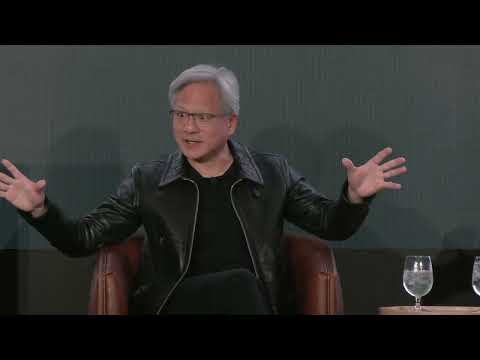
At Stripe Sessions (April 2024) he explained it: people connect passion with happiness, but "when you want to build something great it's not easy to do… I don't love every day of my job… but I love the company every single second." Hence "I wish upon you greatness, which by my way of saying it, I wish upon you plenty of pain and suffering."
| Source | Line | Take it as |
|---|---|---|
| SIEPR Summit, 1 March 2024 | "I wish upon you ample doses of pain and suffering" | resilience is built, not taught |
| Stripe Sessions, April 2024 | "You have to suffer. You have to struggle… in order to really appreciate what you've done" | don't pick work by how pleasant each day is |
| Acquired, October 2023 | "I wouldn't do it… building Nvidia turned out to have been a million times harder than I expected… Nobody in their right mind would do it" | the honest counterweight: he would not start again |
| Acquired, October 2023 | "that's the superpower of an entrepreneur. They don't know how hard it is… To this day, I trick my brain into thinking, how hard can it be?" | naivety is a feature at the start |
| New Yorker, 2023 | on Oneida: "Back then, you just had to toughen up and move on"; "I find that I think best when I'm under adversity… My heart rate actually goes down" | his resilience story is autobiographical |
| NTU commencement, 2023 | the CUDA years "forged our corporate character to endure the pain and suffering that is always needed to realize a vision" | used for companies, not just people |
The Acquired answer is the one to remember. Asked what he would start if he were 30 again in 2023, he said he wouldn't: if the founders had known "the pain and suffering, just how vulnerable you're going to feel… the embarrassment and the shame", nobody would start a company. The same person who wishes suffering on students also says the suffering would have stopped him. The support that got him through, he said, was "family, friends", and colleagues and early investors who "not one time gave up".
Commencement speeches
| Speech | Date | Main points | Key line |
|---|---|---|---|
| National Taiwan University | 27 May 2023 | three near-death stories (Sega, CUDA, the mobile retreat); humility to admit mistakes and ask for help; strategic retreat and sacrifice | "Run, don't walk. Remember, either you're running for food or you are running from being food." |
| Caltech (130th commencement) | 14 June 2024 | believe in something unconventional but reasoned; treat setbacks as opportunities; devotion to craft (a story about a gardener tending a moss garden) | "I hope you'll see setbacks as new opportunities. Your pain and suffering will strengthen your character, your resilience, and agility, and they are your ultimate superpowers." |
From NTU, the passage worth keeping: "Retreat does not come easily to the brightest and most successful people like yourself. Yet strategic retreat, sacrifice, deciding what to give up is at the core, the very core, of success." From Caltech: "I hope you believe in something. Something unconventional, something unexplored. But let it be informed, and let it be reasoned, and dedicate yourself to making that happen."
Critiques and limits
| Issue | What's documented |
|---|---|
| survivorship and timing | Nvidia nearly died in 1996–97 and, by Huang's account, was valued at a few billion dollars or less for years after CUDA. The AI payoff arrived because academic researchers chose GPUs (AlexNet, 2012), a turn Huang did not plan; he calls these moments "a diving catch" and says "You want to position yourself near the tree". The dozens of 1990s graphics start-ups that made equally bold bets are forgotten. |
| 60 direct reports doesn't transfer | Huang himself says it is not "scalable downward". It works for a founder-CEO with 30 years of context, very senior staff and near-total authority; most managers lack all three, and the conventional norm of regular one-on-ones exists because most people need coaching and a private channel. |
| public feedback can humiliate | the New Yorker reports he can "lose his temper" when people fudge answers; Huang: "When the mismatch is great, then it comes out as anger." A former colleague: "I've been afraid of Jensen sometimes." Public correction teaches the room only where safety is high; elsewhere people stop speaking. |
| pain-and-suffering romanticism | the line is advice to elite students with a safety net. His own evidence cuts both ways: he says he wouldn't start again, works seven days a week and is "always in a state of anxiety" (Rogan, December 2025). Suffering is a cost that sometimes comes with great work, not a method for producing it. |
| customer concentration | in fiscal 2026 one direct customer was 22% of revenue and another 14% (Nvidia 10-K); the large cloud companies are also designing their own AI chips |
| supply concentration | Nvidia designs but does not fabricate; its wafers come from foundries such as TSMC and Samsung, and the 10-K flags dependence on supply "from Taiwan and South Korea" |
| export controls and China | US controls on advanced chips to China began in October 2022; in April 2025 a license became required for the H20, leading to a $4.5bn charge; US officials later said they expected 15% or more of licensed-sales revenue (10-K). China (by customer headquarters) fell from $25.0bn (19%) of revenue in fiscal 2025 to $19.7bn (9%) in fiscal 2026. In September 2025 China's internet regulator told major firms to stop buying Nvidia's China-specific RTX Pro 6000D. |
| antitrust | FTC suit to block the Arm deal (December 2021; abandoned February 2022); French competition authority search of Nvidia's offices (September 2023); US Justice Department investigation opened June 2024; China's SAMR opened a probe in December 2024 and on 15 September 2025 said a preliminary finding showed Nvidia broke its anti-monopoly law over conditions attached to the Mellanox deal |
| his numbers drift | direct reports go from 40 to 50 to 60 across a year of interviews; his low-point market cap is "just above $1 billion" at NTU and "a couple of $2–$3 billion" on Acquired. Quote the source, not the meme. |
Blunt conclusion: the strategic habits (admit the mistake, simulate before betting, track early indicators, benchmark against the physical limit, keep one architecture compatible for decades) are sound and cost nothing to copy. The organisational ones (60 reports, no one-on-ones, public critique) are tuned to one founder with unusual authority and an unusually senior team. The pain-and-suffering rhetoric describes his path; it is not evidence that suffering causes success.
What transfers to a small startup
| Transfers | Doesn't transfer |
|---|---|
| telling a customer or partner early that your approach is wrong | a decade in a zero-billion-dollar market without a cash-generating core |
| verifying the risky part before the big commitment (prefetch the future) | betting the company on one tape-out without the emulator |
| early indicators of future success when revenue is too early to judge | ignoring results indefinitely because you "believe" |
| "speed of light" estimates that expose waiting and hand-offs | 60 direct reports once you have managers who are new to managing |
| everyone hears decisions and reasoning at the same time | public criticism without trust built first |
| a weekly five-bullet note from everyone | reading 100 of them a day instead of doing the work |
| one concrete mission per project as the "boss" | "no plan" as an excuse for no priorities |
| strategic retreat from a crowded side-market | romanticising suffering for yourself or your team |
Where each piece applies
| Pipeline phase | Huang idea | Where |
|---|---|---|
| Operating | mission is the boss; rolling priorities, not annual plans; decisions made in the open | playbook |
| Ideation | zero-billion-dollar markets; "would it happen without us?"; hard problems as moats | ideation |
| Validation | early indicators of future success; prefetch the riskiest assumption | validation |
| Product design | first principles on the workflow; work backwards from the end state | product design |
| Building | speed-of-light estimates; one compatible architecture; simulate before committing | building the MVP |
| Launch and iterate | admit a wrong approach early; strategic retreat from segments you can't win | launch and iterate |
Takeaways checklist
[ ] I told someone this week about a mistake in our
    approach, and asked for help if we need it
[ ] The riskiest part of the next big commitment was
    tested or simulated before we committed
[ ] Each bet has 2-3 early indicators we check weekly
[ ] I estimated the "speed of light" for our next
    milestone and listed every wait in the plan
[ ] We asked "would this happen without us?" before
    starting a new project
[ ] Decisions and their reasoning are shared with the
    whole team at the same time
[ ] Everyone sends a five-bullet weekly note; I read
    them looking for weak signals
[ ] Each project has one concrete mission and one owner
[ ] Our priorities are reviewed continuously, not
    once a year
[ ] Post-mortems are presented to everyone, without
    blame
[ ] I cut or retreated from one crowded side-market
[ ] Nobody, including me, is running on anxiety alone
References
- Stanford GSB, "Jensen Huang on How to Use First-Principles Thinking to Drive Decisions" (25 April 2024) (opens in a new tab): View From The Top interview with Shantam Jain, with full transcript (founding, OpenGL reset, early indicators, 50 direct reports, first principles, org design)
- Stanford GSB, ENCORE Award (opens in a new tab): dates the View From The Top appearance to 1 March 2024
- SIEPR, "Nvidia's Jensen Huang: The incredible future of AI" (7 March 2024) (opens in a new tab): the "ample doses of pain and suffering" line at the 2024 SIEPR Economic Summit
- SIEPR, "2024 SIEPR Economic Summit" (opens in a new tab): summit date (1 March 2024)
- SIEPR, "Keynote by NVIDIA CEO Jensen Huang at 2024 SIEPR Economic Summit" (YouTube) (opens in a new tab): the primary video
- Fortune, "Nvidia founder tells Stanford students their high expectations may make it hard for them to succeed" (13 March 2024) (opens in a new tab): fuller quotes on expectations and resilience
- Stripe Sessions, "A conversation with NVIDIA's Jensen Huang" (April 2024) (opens in a new tab): with Patrick Collison; transcript covering 60 direct reports, no one-on-ones, public feedback, zero-billion-dollar markets, CUDA and tenure
- Acquired, "NVIDIA CEO Jensen Huang" (15 October 2023) (opens in a new tab): transcript; RIVA 128 emulation, "mission is the boss", Mellanox, zero-billion-dollar markets, "I wouldn't do it"
- Fortune, "Nvidia cofounder Jensen Huang says 'nobody in their right mind' would start a company" (23 October 2023) (opens in a new tab): report of the Acquired remarks
- Stephen Witt, "How Jensen Huang's Nvidia Is Powering the A.I. Revolution", The New Yorker (27 November 2023) (opens in a new tab): Oneida, the 1996 layoffs, "thirty days from going out of business", speed of light, T5T, failure must be shared, AlexNet
- Kevin Xu, "Jensen Huang NTU Commencement Speech 2023" (Interconnected) (opens in a new tab): full text of the 27 May 2023 address
- National Taiwan University, "NTU Commencement 2023" (opens in a new tab): the university's account of the ceremony
- Caltech, "Caltech Honors Graduates at 130th Commencement Ceremony" (June 2024) (opens in a new tab): the 14 June 2024 address
- Nvidia Blog, "'Believe in Something Unconventional, Something Unexplored,' NVIDIA CEO Tells Caltech Grads" (June 2024) (opens in a new tab): further quotes from the Caltech speech
- Tom's Hardware, "Jensen Huang's Unusual Nvidia Management Style Doesn't Include Long-Term Plans or Reports" (September 2023) (opens in a new tab): quotes the "no five-year plan" answer from Sana's Strange Loop interview
- Sana, "Leading the teams behind the world's fastest AI | Jensen Huang | Strange Loop" (YouTube, 2023) (opens in a new tab): the interview with Joel Hellermark
- Fortune, "Jensen Huang's Top 5 Things emails" (13 December 2024) (opens in a new tab): T5T and "detect the weak signals", from Tae Kim's book
- Jeremy Kahn, "60 direct reports, but no 1-on-1 meetings", Fortune (12 November 2024) (opens in a new tab): the management system at the time of Fortune's power list
- Fortune, "Nvidia CEO admits he works 7 days a week… in a constant 'state of anxiety'" (4 December 2025) (opens in a new tab): report of the Joe Rogan Experience remarks on "30 days"
- Tae Kim, The Nvidia Way: Jensen Huang and the Making of a Tech Giant (W. W. Norton, 2024): company history, T5T, early life
- Stephen Witt, The Thinking Machine: Jensen Huang, Nvidia, and the World's Most Coveted Microchip (Viking, 2025): biography; source for the Taipei birthplace
- Alex Krizhevsky, Ilya Sutskever and Geoffrey Hinton, "ImageNet Classification with Deep Convolutional Neural Networks" (NeurIPS 2012) (opens in a new tab): AlexNet, trained on two GTX 580 GPUs
- Nvidia, Form 10-K for fiscal year ended 25 January 2026 (SEC) (opens in a new tab): revenue, customer concentration, foundry dependence, H20 charge, China revenue
- Nvidia Newsroom, "NVIDIA to Acquire Mellanox for $6.9 Billion" (11 March 2019) (opens in a new tab): the deal announcement
- FTC, "FTC Sues to Block $40 Billion Semiconductor Chip Merger" (2 December 2021) (opens in a new tab): the Arm challenge
- NBC News, "U.S. regulators open antitrust probes into Nvidia, Microsoft and OpenAI" (June 2024) (opens in a new tab): the DOJ taking the Nvidia investigation
- CNBC, "China says Nvidia violated anti-monopoly law, will continue investigation" (15 September 2025) (opens in a new tab): SAMR's preliminary finding
- Washington Post, "Nvidia becomes first $4 trillion company at market close" (10 July 2025) (opens in a new tab): the $4 trillion milestone
- Reuters, "Nvidia hits $5 trillion valuation as AI boom powers meteoric rise" (29 October 2025) (opens in a new tab): the $5 trillion milestone
- Wikipedia, "Jensen Huang" (opens in a new tab) and "Nvidia" (opens in a new tab): sourced timelines (birth, education, NV1, Sega's $5m investment, RIVA 128, IPO, market-cap milestones, French and Chinese regulatory actions)
- Wikipedia, "GeForce 256" (opens in a new tab) and "CUDA" (opens in a new tab): the "world's first GPU" marketing and CUDA's 2006 introduction