Running warm-up drills
How to warm up before a run, a workout or a race: the RAMP structure, how long to spend by session, a drill catalog with cues, strides, stretching before running, and race-day timing. Post-run stretching and recovery are in stretching & recovery; pacing and session types in endurance; warm-up sets for lifting in strength training.
Why warm up
| Effect | Numbers | Source |
|---|---|---|
| muscle temperature rises | 2.7–3.3 °C above rest after an active warm-up | Raccuglia et al. 2016 |
| faster, stronger muscle | short efforts improve 2–5 % per 1 °C of muscle temperature | Racinais & Oksa 2010 |
| performance overall | warm-up improved performance in 79 % of criteria (32 high-quality studies) | Fradkin et al. 2010 |
| oxygen uptake primed | starting with raised baseline VO₂ helps efforts from ~10 s to over 5 min, if you start unfatigued | Bishop 2003 |
| heat is lost quickly | muscle temperature falls exponentially within 15–30 min of stopping; ~1.3 °C in 30 min unheated | Raccuglia et al. 2016 |
Injury prevention: what the evidence covers
| Program or study | Result |
|---|---|
| FIFA 11+ (Soligard 2008), 1892 girls aged 13–17 | injury risk ratios: overall 0.68, severe 0.55, overuse 0.47 over one season |
| FIFA 11+ meta-analysis (Thorborg 2017) | 39 % fewer football injuries overall |
| warm-up, cool-down and stretching for runners (van Mechelen 1993), 326 men, 16 weeks | no effect: 5.5 vs 4.9 injuries per 1000 h (intervention vs control) |
FIFA 11+ is a 20-min football program of running, strength, plyometric and balance work, not a jog and stretch; its benefit comes from that neuromuscular training. For recreational runners the injury case for a warm-up is weak. Warm up to run better in hard sessions and races, and to feel better in the first kilometers.
The RAMP framework
Ian Jeffreys' structure (2007) for any warm-up: each phase leads into the next, and the last phase looks like the session itself.
| Phase | Goal | For running | Time |
|---|---|---|---|
| Raise | heart rate, blood flow, muscle and core temperature | easy jog, skipping, march | 5–15 min |
| Activate | switch on the muscles the session will load | glute bridges, band walks, calf raises, pogo hops | 2–4 min |
| Mobilise | take joints through the ranges the session needs | leg swings, lunge with twist, hip circles, ankle rocks | 2–4 min |
| Potentiate | raise intensity to or above session pace | A-skips, B-skips, bounds, strides, a short rep at race pace | 2–6 min |
Activate and mobilize are often combined into one circuit of drills. An easy run needs only the raise phase; a race or interval session needs all four.
Watch a full RAMP-style warm-up: raise, activation, mobility, then running drills.

How long to warm up
Longer and harder sessions need the warm-up less, and shorter and faster ones need it more. Durations are coaching practice; the two trials in the notes back high-intensity efforts in the warm-up for middle distance.
| Session | Warm-up | Total |
|---|---|---|
| easy or recovery run | walk 1–2 min, then run the first 5–10 min slower than easy pace | 0–5 min |
| long run | as easy run; optional leg swings | 0–5 min |
| tempo or threshold | 10–15 min easy, drills, 3–4 strides | 15–20 min |
| intervals or track | 10–15 min easy, drills, 4–6 strides, 1–2 short reps at session pace | 20–30 min |
| 5 k or 10 k race | 10–15 min easy, drills, 4–6 strides, 1–2 × 30–60 s at race pace | 20–30 min |
| half marathon | 10 min easy, 2–4 strides | 10–15 min |
| marathon | 5–10 min walk and jog, 1–3 relaxed strides, or none; the first km is the rest of it | 0–10 min |
Notes:
- The marathon warm-up is short to save glycogen: race pace is sustainable from the gun, and the extra fuel cost of a long jog outweighs any gain.
- In a 5000 m trial, a warm-up with 3 × 250 m at 100 % effort beat the same warm-up at 70 % by 6.4 s (~0.5 %; Alves et al. 2023). An 800 m trial found the same with a 200 m run at race pace (Ingham et al. 2013).
Drill catalog
Do drills on a flat 20–30 m stretch, walking or jogging back as recovery. Reps are coaching practice, not from trials. Quality over quantity: stop a drill when form breaks.
| Drill | What it trains | Dose | Key cue | Common fault |
|---|---|---|---|---|
| march (A-march) | posture, knee lift, foot placement under the hip | 2 × 20 m | tall, knee to hip height, toes up, step down under the hip | leaning back, reaching the foot forward |
| A-skip | rhythm, knee drive, active ground contact | 2–3 × 20 m | skip with a high knee, punch the foot down under the hip | loud heel strike, slow and floaty skip |
| B-skip | A-skip plus pawing the leg back: hamstring action | 2 × 20 m | lift, extend the lower leg, sweep it down and back | kicking out straight and landing ahead of the body |
| high knees | cadence, hip flexor drive | 2 × 15–20 m | quick, short contacts on the balls of the feet; stay tall | sitting back, arms flailing |
| butt kicks | quick heel recovery, quad and knee range | 2 × 15–20 m | heel to the backside under the hip, not behind | knee drifting back, slow cadence |
| carioca (grapevine) | hip rotation, lateral movement, coordination | 2 × 20 m each way | shoulders square, hips rotate, light feet | shoulders twisting with the hips, crossing feet slowly |
| straight-leg bounds | hamstrings, glutes, stiff springy contact | 2 × 20 m | nearly straight legs, pull the ground back under you | bending the knees, bouncing on the heels |
| pogo hops | ankle and Achilles stiffness, elastic return | 2 × 10–20 hops | stiff ankles, quick contacts, heels just off the ground | bending knees to jump, sinking into the heels |
| skips for height | power, triple extension | 2 × 20 m | drive the knee and opposite arm up, push tall off the floor | going forward instead of up |
| skips for distance | horizontal power | 2 × 20 m | long, powerful push; land under the hip | overreaching and braking on landing |
| leg swings, front-back | hip flexor and hamstring mobility | 10–15 per leg | hold a wall, swing from the hip, trunk still | arching the lower back to fake range |
| leg swings, side-side | adductor and abductor mobility | 10–15 per leg | face the wall, swing across the body and out | rotating the pelvis |
| walking lunge with twist | hip flexor length, thoracic rotation, balance | 5–6 per side | long step, rotate the trunk over the front leg | front knee collapsing inward |
| hip circles (open-close gate) | hip rotation range | 5–8 each way per leg | knee up, circle it out and back; stand tall | leaning the trunk to cheat range |
| ankle rocks | ankle dorsiflexion (calf and Achilles) | 10–15 per side | half-kneel or stand, drive the knee over the toes, heel down | heel lifting off the floor |
| strides | speed, relaxed form at fast pace, potentiation | 4–6 × 15–20 s | build over 5–10 s to ~85–90 %, hold, then ease off | sprinting all-out, short recovery |
Watch several of these in one sequence, with cues.

A-skips and B-skips
The A-skip is a skipping march: one high knee per skip, foot punched down under the hip. The B-skip adds an extension of the lower leg at the top and a pulling "paw" back to the ground. Learn A before B; if the B-skip turns into a kick forward, go back to A-skips.
Watch for the foot landing under the hip, not ahead of it, and the rhythm of the skip.

Strides
Short relaxed accelerations: the potentiate phase of most warm-ups, and speed work after easy runs.
- Flat 80–100 m, grass or track.
- Accelerate smoothly over 5–10 s to about 85–90 % of top speed; hold 5–10 s; ease off. 15–20 s in all.
- Walk back or stand: full recovery, 45–90 s, so every stride is fast and relaxed.
- 4–6 reps. Cues: tall, relaxed face and hands, quick feet, arms drive back.
Watch for the gradual build-up and how relaxed the runners stay at speed.
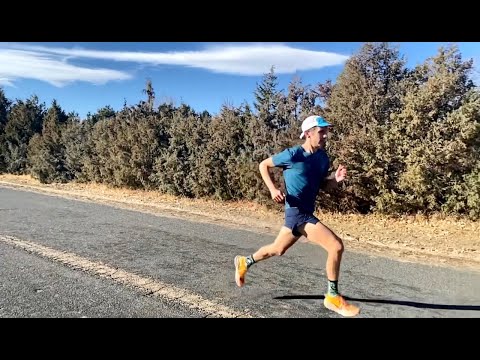
Stretching before running
Behm et al. (2016) pooled studies that tested performance 3–5 min after stretching:
| Stretch type | Change in performance straight after | Notes |
|---|---|---|
| static, under 60 s per muscle | −1.1 % | trivial, and smaller still if dynamic activity follows |
| static, ≥ 60 s per muscle | −4.6 % | avoid long holds right before a race |
| static, all durations | −3.7 % | bigger drop in strength (−4.8 %) than speed and power tests (−1.3 %) |
| PNF | −4.4 % | do it well before (over 10 min) or after the session |
| dynamic | +1.3 % | best close to the start |
- All types raise range of motion for under ~30 min.
- In sprint-type sports, pre-exercise stretching was linked with ~54 % fewer acute muscle injuries (6 studies); in endurance running there was no effect on overuse injuries.
- For runners: short static holds (under 60 s per muscle) for a tight spot are fine if drills and strides come after them. Otherwise favor dynamic drills.
Race-day timing
| Minutes before the start | What to do |
|---|---|
| 45–30 | last toilet stop; start the easy jog (5 k and 10 k) |
| 30–20 | drills and strides |
| 20–15 | race-pace efforts, if used; finish the main warm-up 10–15 min before the start |
| 15–0 | keep warm and moving: layers or a throwaway top on, walk, light skips; 1–2 strides if the start pen allows |
- Muscle temperature falls within 15–30 min of stopping (Raccuglia 2016); insulating layers slow the loss. The 5000 m trial above left ~18 min between warm-up and start, with drills in the gap.
- Too hard or too close to the start fatigues you (Bishop 2003): keep race-pace bits short (30–60 s) and fully recovered.
- Big races with long start pens: warm up, keep layers on, and do leg swings and short jogs in the pen.
Weather adjustments
| Condition | Adjust |
|---|---|
| cold (rough guide: under ~5 °C) | longer raise phase; keep tights, hat and gloves on until the last minutes; warm up indoors if possible; shorter gap to the start |
| cold and wet or windy | throwaway top or bin bag in the start pen; drills under cover |
| hot (rough guide: over ~20 °C) or humid | shorter, easier warm-up in the shade: keep the drills and 2–4 strides, cut the jog; start well hydrated; a cooling vest or cold towel during the warm-up |
| hot, long race | minimal warm-up; start conservatively; see endurance for heat pacing |
Cooling garments lower skin temperature without cooling the muscles, so they can be worn during a warm-up; cold-water leg immersion cools muscle too, so re-warm afterward (Racinais et al. 2015 heat consensus). Heat illness signs (confusion, stopping sweating, collapse) need urgent medical help.
Drills as technique work
- The same drills done as a stand-alone session (2 × a week, 10–20 min after an easy run) rehearse posture, foot placement and rhythm at low fatigue.
- Evidence is limited: drills clearly build coordination and elastic stiffness (pogo hops, bounds), but proof that they change distance-running form or economy is thin (Moore 2016: be cautious about prescribing one "economical" technique).
- Use them for: coordination, lower-leg stiffness, and a cue to carry into the run ("tall", "feet under hips"). Don't force a new foot strike.
- Progress: marches → skips → bounds; walking → skipping → running pace. Stop when form breaks.
Recipes
10-minute easy-run warm-up
For easy and long runs, when the first kilometers feel stiff.
2 min   brisk walk
2 min   leg swings, front-back and side-side (10 each leg), 8 hip circles each way
1 min   ankle rocks (10 per side), 10 pogo hops
5 min   start the run 30-60 s/km slower than easy pace, build to easy
20-minute workout or 5 k / 10 k race warm-up
For intervals, tempo runs and short races. Finish 10–15 min before a race start.
10-12 min  easy jog, last 2 min at steady pace
 4 min     A-march, A-skip, B-skip, high knees, butt kicks (1 x 20 m each)
           leg swings (10 each way per leg), walking lunge with twist (5 per side)
 4 min     4 strides x 15-20 s, build to ~90 %, walk back
 2 min     race only: 1-2 x 30-60 s at race pace, 60-90 s easy between
Marathon warm-up (minimal)
For the marathon, to save glycogen; the first 1–2 km at goal pace or slightly slower finish the job.
-40 min   5 min easy walk, 5 min very easy jog
-30 min   leg swings (10 each way per leg), hip circles, ankle rocks
-25 min   1-3 relaxed strides (optional)
 0-15 min into the pen: keep a throwaway top on, walk, shake out
Track session warm-up
For VO₂ max reps, 200–400 m repeats and hill sprints.
12-15 min  easy jog, last 3 min steady
 3 min     leg swings, walking lunges with twist, hip circles
 6 min     march, A-skip, B-skip, carioca, straight-leg bounds, pogo hops
           (2 x 20 m each, walk back)
 5 min     5 strides x 20 s, build to 90 %; last one at session pace
 2 min     rest, then start the first rep
5-minute "desk to door" warm-up
For a lunch-hour or after-work run after hours of sitting: undoes stiff hips and calves.
- 20 bodyweight squats or sit-to-stands, slowly (30 s).
- Walking lunge with twist, 5 per side (1 min).
- Leg swings front-back and side-side, 10 each per leg (1 min).
- Ankle rocks, 10 per side; 20 calf raises (1 min).
- March on the spot, then 30 s high knees and 30 s butt kicks (1.5 min).
- Start the run gently for the first 5 min.
Drills-only technique session
For 1–2 sessions a week, after an easy run on grass or a track, 15–20 min in all.
| Block | Drills | Dose |
|---|---|---|
| coordination | A-march, A-skip, B-skip | 2 × 20 m each, walk back |
| elastic | pogo hops (both legs, then single leg) | 2 × 15 hops each |
| power | skips for height, skips for distance, straight-leg bounds | 2 × 20 m each, full walk back |
| lateral | carioca both ways | 2 × 20 m each |
| transfer | strides, carrying the drill cue ("feet under hips") | 4 × 20 s |
Add hops and bounds gradually if new to plyometrics, and not the day before a hard session.
References
- Jeffreys I, Warm-up revisited: the RAMP method of optimizing warm-ups (opens in a new tab), Professional Strength & Conditioning (2007): the RAMP phases
- Fradkin AJ et al., Effects of warming-up on physical performance: a systematic review with meta-analysis (opens in a new tab), J Strength Cond Res (2010): 79 % of criteria improved
- Bishop D, Warm up II: performance changes following active warm up and how to structure the warm up (opens in a new tab), Sports Med (2003): intensity, recovery and raised baseline VO₂
- Racinais S, Oksa J, Temperature and neuromuscular function (opens in a new tab), Scand J Med Sci Sports (2010): 2–5 % per °C
- Raccuglia M et al., Post-warm-up muscle temperature maintenance (opens in a new tab), Eur J Appl Physiol (2016): temperature rise and loss after a warm-up
- Soligard T et al., Comprehensive warm-up program to prevent injuries in young female footballers (opens in a new tab), BMJ (2008): FIFA 11+ trial
- Thorborg K et al., Effect of FIFA 11 and 11+ programs on the overall injury rate in football (opens in a new tab), Br J Sports Med (2017): 39 % reduction
- van Mechelen W et al., Prevention of running injuries by warm-up, cool-down, and stretching exercises (opens in a new tab), Am J Sports Med (1993): no effect in recreational runners
- Behm DG et al., Acute effects of muscle stretching on physical performance, range of motion, and injury incidence (opens in a new tab), Appl Physiol Nutr Metab (2016): stretch type and dose before exercise
- Alves et al., Effects of high-intensity warm-up on 5000-meter performance time in trained long-distance runners (opens in a new tab), J Sports Sci Med (2023)
- Ingham SA et al., Improvement of 800-m running performance with prior high-intensity exercise (opens in a new tab), Int J Sports Physiol Perform (2013)
- Racinais S et al., Consensus recommendations on training and competing in the heat (opens in a new tab), Sports Med (2015): cooling and warm-up in the heat
- Moore IS, Is there an economical running technique? A review of modifiable biomechanical factors affecting running economy (opens in a new tab), Sports Med (2016)
- The Running Channel, Follow-along warm-up for running (opens in a new tab): a RAMP routine for runners, with drills