Credit & debt
How US credit reports and scores work, how credit cards and loans are priced, the math of amortization, mortgages, car and student loans, how to get out of debt (avalanche vs snowball), your rights with debt collectors, bankruptcy in brief and the traps in buy now, pay later. Written for a US-based reader: credit bureaus, scoring models and consumer law differ a lot elsewhere. Where the next dollar should go is in money basics, card protections and payment rails in banking, identity theft and credit freezes in insurance and estate, and the tax side of mortgages and student loans in retirement and taxes.
Credit reports
A credit report is the record lenders furnish to the three nationwide credit reporting agencies (bureaus): Equifax, Experian, TransUnion. Each bureau's file can differ, because not every lender reports to all three. A credit score is a number computed from a report; the report is the raw material.
| What's on it | What's not on it |
|---|---|
| identity: names, addresses, SSN, date of birth, employers | income, bank balances, savings, investments |
| accounts (tradelines): cards, loans, mortgages; limits, balances, payment history | race, religion, national origin, sex, marital status |
| collections accounts | checking and debit-card activity (with rare opt-in exceptions) |
| public records: bankruptcies | criminal records, most medical detail |
| hard inquiries (applications) | your own checks of your credit (soft inquiries show only to you) |
Free reports: every person can get a free report from each of the three bureaus every week at AnnualCreditReport.com (opens in a new tab), the only site authorized under federal law. Weekly access started in 2020 as a pandemic measure and was made permanent by the bureaus in 2023 (the law itself only guarantees one a year). Specialty agencies (for example ChexSystems for bank accounts, tenant-screening companies) must also provide free reports on request.
How long negative items stay
| Item | Reporting limit under the Fair Credit Reporting Act (FCRA) |
|---|---|
| late payments, charge-offs, collections | 7 years (from the date of first delinquency for collections and charge-offs) |
| Chapter 7 bankruptcy | 10 years from the filing |
| Chapter 13 bankruptcy | up to 10 years allowed; the bureaus generally remove it after 7 |
| lawsuits and judgments | 7 years or the statute of limitations, whichever is longer |
| hard inquiries | stay 2 years; FICO counts only the last 12 months |
| positive, closed-in-good-standing accounts | often around 10 years (bureau practice) |
Paying a collection does not remove it (except paid medical collections, below); it changes the status to paid. Re-aging a debt (resetting the 7-year clock) is illegal.
Disputes
- Pull all three reports and mark every error: accounts you don't recognize, wrong balances, late payments you didn't make, outdated items, wrong personal details.
- Dispute with each bureau reporting the error (online, or by certified mail with copies of evidence), and with the furnisher (the lender or collector) directly.
- Bureaus generally must investigate within 30 days and forward your dispute to the furnisher; furnishers generally must investigate and respond within 30 days of receiving a direct dispute.
- If the item is verified but you still disagree, add a statement to your file and complain to the CFPB (opens in a new tab).
Beware credit repair companies that promise to remove accurate negative information: nobody can legally do that, and everything they can do, you can do for free.
Medical debt, 2026 status
| Date | Change |
|---|---|
| July 2022 | the three bureaus (voluntarily) removed paid medical collections and delayed reporting unpaid ones for one year |
| April 2023 | the bureaus stopped reporting medical collections under $500 |
| January 2025 | the CFPB finalized a rule to remove medical debt from credit reports used by lenders |
| 11 July 2025 | a federal court in the Eastern District of Texas vacated that rule, at the joint request of the CFPB and industry plaintiffs; it never took effect |
So in 2026 there is no federal ban; the bureaus' voluntary policies (paid and under-$500 medical collections excluded, one-year delay) still apply. Several states have their own medical-debt reporting laws, but the same court said the FCRA pre-empts such state laws, so their effect is contested; check your state.
Credit scores
A credit score predicts the chance you will be 90+ days late on a debt within the next two years. The main families are FICO and VantageScore, both usually on a 300–850 scale, with many versions (FICO 8 is the most widely used for cards and auto loans; mortgages have historically used older "classic" FICO versions).
FICO factor weights (myFICO, for the general population)
| Factor | Weight | What helps |
|---|---|---|
| payment history | 35% | never late; one 30-day late payment can cost a strong score dearly |
| amounts owed | 30% | low utilization (balance ÷ limit), overall and per card; paying down installment loans |
| length of credit history | 15% | old accounts kept open; high average age |
| new credit | 10% | few recent hard inquiries and new accounts |
| credit mix | 10% | a mix of revolving (cards) and installment loans; don't borrow just for this |
Utilization: the balance reported on your statement counts, even if you pay in full afterward. Under 30% is the common rule of thumb; single-digit utilization is associated with the highest scores. Because utilization has no memory in most scoring models, a high balance hurts only until the next statement: it matters in the month or two before a big loan application.
Newer models: FICO 10T and VantageScore 4.0 use trended data (whether balances are rising or falling over time, not just this month's snapshot). The FHFA announced in July 2025 that lenders could use VantageScore 4.0 for loans sold to Fannie Mae and Freddie Mac, with implementation announced in April 2026; FICO 10T is also approved, with rollout ongoing.
What does not affect your score
| Doesn't affect it | Why |
|---|---|
| checking your own score or report | soft inquiry |
| pre-approved offers, account reviews by existing lenders | soft inquiries |
| income, job, savings, net worth | not on the report (lenders ask separately) |
| debit cards and checking accounts | not reported to the big three |
| rent and utilities | only if reported (some services add them on request) |
| race, color, religion, national origin, sex, marital status, age | not used by FICO; the Equal Credit Opportunity Act bars lenders discriminating on them |
| paying interest | carrying a balance does not help your score; paying in full is scored the same or better |
Hard vs soft inquiries
| Hard inquiry | Soft inquiry | |
|---|---|---|
| trigger | you apply for credit | you check your own credit; pre-approvals; employer checks; existing-lender reviews |
| visible to lenders | yes | no |
| score impact | small (typically a few points), fades over 12 months | none |
| rate shopping | mortgage, auto and student-loan inquiries within a window count as one: 45 days for newer FICO versions, 14 days for older ones; FICO also ignores such inquiries in the 30 days before scoring | – |
Card applications are not grouped: each is its own hard inquiry. Shop for a mortgage or car loan within two weeks to be safe with every model.
Credit cards
A credit card is a revolving line: borrow up to a limit, repay any amount above the minimum, borrow again.
| Term | Meaning |
|---|---|
| APR | annual rate on balances; purchase, balance-transfer, cash-advance and penalty APRs can all differ. Average for accounts assessed interest: 22.15% (Fed G.19, Q2 2026); all accounts 20.94% |
| statement balance | what you owed at the close of the billing cycle |
| grace period | if you paid the previous statement balance in full, no interest on new purchases until the due date; the CARD Act (2009) requires the bill to arrive at least 21 days before it is due |
| losing the grace period | carry any balance and new purchases accrue interest from the day they post; you usually need to pay in full for one or two cycles to get it back ("trailing" or residual interest) |
| minimum payment | often interest + 1% of the balance, or a small percentage, with a floor of about $25–$40 |
| payment allocation | anything above the minimum must go to the highest-APR balance first (CARD Act) |
| cash advance | higher APR, no grace period, plus a fee; avoid |
| penalty APR | can apply to existing balances only after a payment is 60+ days late (CARD Act) |
The minimum payment trap
$5,000 at 22% APR, no new spending (monthly compounding at ). First month's interest: dollars.
| Payment strategy | First payment | Months to pay off | Total interest |
|---|---|---|---|
| minimum = interest + 1% of balance, $35 floor | $141.67 | 197 (16.4 years) | $7,673 |
| minimum = 3% of balance, $35 floor | $150.00 | 176 (14.7 years) | $6,677 |
| fixed $141.67 (freeze the first minimum) | $141.67 | 58 (4.8 years) | $3,121 |
| fixed $200 | $200 | 34 (2.8 years) | $1,750 |
| fixed $500 | $500 | 12 | $574 |
(Computed month by month in Python and cross-checked with the payoff formula , which gives 33.7 months at $200.)
The trap is that the minimum shrinks as the balance falls, so the payoff drags on for years and you pay more in interest than you borrowed. Freezing the payment at the first month's minimum cuts the time from 16 years to under 5. Statements must show this: the CARD Act "minimum payment warning" box gives the time and cost of paying only the minimum and the payment needed to clear the balance in three years.
Using cards well
- Autopay the statement balance in full, every month. Then the APR is irrelevant and the card is a free, well-protected payment tool (see banking).
- Rewards math: 2% cash back on $2,000 a month is $480 a year. A $5,000 balance at 22% costs about $1,100 a year in interest. Rewards only work if you never pay interest.
- Annual fees: worth it only if credits and rewards you would actually use exceed the fee.
- Keep old no-fee cards open (age and total limit); use them occasionally so they aren't closed for inactivity.
- Balance transfers: move a balance to a 0% introductory APR card for a fee (commonly 3–5%). Worked: $5,000 with a 3% fee costs $150 up front; clearing the same $5,000 in 15 months at 22% would need $384.29 a month and cost $764 in interest. It works only if you stop adding debt and clear it before the promo ends. Retail "deferred interest" (no interest if paid in full) is a different, nastier product: miss the deadline and all the interest back to day one is charged.
Loan math
A standard amortizing loan has a fixed payment; each payment covers that month's interest first, and the rest reduces principal. For principal , monthly rate (APR/12) and monthly payments:
Worked: $400,000, 30-year fixed at 6.5%
, , so dollars a month (principal and interest only; taxes and insurance come on top).
| Month | Payment | Interest | Principal | Balance |
|---|---|---|---|---|
| 1 | $2,528.27 | $2,166.67 | $361.61 | $399,638.39 |
| 2 | $2,528.27 | $2,164.71 | $363.56 | $399,274.83 |
| 3 | $2,528.27 | $2,162.74 | $365.53 | $398,909.30 |
| 4 | $2,528.27 | $2,160.76 | $367.51 | $398,541.78 |
| 5 | $2,528.27 | $2,158.77 | $369.50 | $398,172.28 |
| 6 | $2,528.27 | $2,156.77 | $371.51 | $397,800.77 |
| After | 1 year | 5 years | 10 years | 15 years | 20 years | 25 years | 30 years |
|---|---|---|---|---|---|---|---|
| balance | $395,529 | $374,444 | $339,105 | $290,237 | $222,661 | $129,217 | $0 |
- Total paid $910,178; total interest $510,178, more than the amount borrowed.
- Principal first exceeds interest in month 233 (about year 19.4).
- After 10 years of payments ($303,393) the balance has fallen only $60,895.
- The same loan over 15 years at 6.0% (15-year rates are usually lower) costs $3,375.43 a month and $207,577 in total interest: 34% more per month, 59% less interest.
- Prepaying principal early saves the most, because it removes years of interest on that amount. It is a guaranteed, tax-free return equal to the mortgage rate (less any interest deduction you actually use).
Mortgages
| Type | How it works | Suits |
|---|---|---|
| 30-year fixed | rate and payment fixed for the life of the loan; prepay any time | most buyers; the US norm (rare internationally) |
| 15-year fixed | lower rate, much higher payment, far less interest | high income relative to price, near retirement |
| ARM, e.g. 5/6 ARM | fixed for 5 years, then adjusts every 6 months to an index (usually SOFR) plus a margin, within caps (e.g. 2/1/5: first adjustment, later adjustments, lifetime) | sure you will sell or refinance before the reset; can afford the lifetime cap |
| FHA | government-insured; down payment from 3.5%; mortgage insurance premium (MIP) for the life of the loan if under 10% down, 11 years otherwise | lower credit scores or savings |
| VA | for eligible veterans and service members; often 0% down, no monthly mortgage insurance, a funding fee | eligible borrowers: usually the best deal available |
| conventional, under 20% down | private mortgage insurance (PMI) until equity reaches 20–22% | most first-time buyers |
Points: one discount point costs 1% of the loan and buys a lower rate (how much varies by lender and market). Worked: on $400,000 at 6.5%, paying one point ($4,000) for 6.25% cuts the payment from $2,528.27 to $2,462.87, saving $65.40 a month: break-even months (about 5 years). Only worth it if you will keep the loan well past break-even, without refinancing.
PMI and when it drops
Under the Homeowners Protection Act (1998), for conventional loans:
| Trigger | Rule |
|---|---|
| borrower request | you may ask to cancel when the balance reaches 80% of the original value (the lower of price or appraisal), if payments are current, you have a good payment history and no second liens; the lender may require proof the value hasn't fallen |
| automatic termination | PMI must end when the balance is scheduled to reach 78% of original value, if you are current |
| final termination | at the loan's amortization midpoint (month 181 of 30 years) if current |
| earlier via appreciation | many investors allow removal based on a new appraisal after some years; this is lender policy, not the Act |
Worked: $450,000 home, 10% down, $405,000 at 6.5% for 30 years ($2,559.88 a month). The balance reaches 80% of original value ($360,000) in month 95 (about 7.9 years), and 78% ($351,000) in month 109 (about 9.1 years). Extra principal payments bring both dates forward.
Affordability rules
| Rule | Limit | Status |
|---|---|---|
| front-end ratio | housing payment (principal, interest, taxes, insurance, HOA, PMI) ≤ 28% of gross monthly income | traditional guideline |
| back-end ratio (DTI) | all monthly debt payments including housing ≤ 36% of gross | traditional guideline |
| Qualified Mortgage 43% DTI | the CFPB's 2014 General QM definition capped DTI at 43% | replaced by price-based limits (rule issued December 2020, mandatory from October 2022); lenders must still consider DTI or residual income |
| agency underwriting | Fannie Mae's automated underwriting can approve DTI up to about 50% | what you can borrow is not what you should |
| QM features | no interest-only, no negative amortization, no balloons (small-creditor exceptions), term ≤ 30 years, points-and-fees cap | makes a loan presumptively compliant with ability-to-repay |
Worked on $8,000 a month gross: 28% → $2,240 housing; 36% → $2,880 all debt.
Closing costs (lender fees, title, appraisal, escrow set-up, transfer taxes) are commonly quoted as 2–5% of the loan amount and vary hugely by state. You get a Loan Estimate within three business days of applying and a Closing Disclosure at least three business days before closing: compare them line by line, and compare Loan Estimates from at least three lenders.
Refinancing break-even: months = closing costs ÷ monthly saving. The old "refinance when rates fall 1%" rule is crude; do the break-even against how long you will keep the loan.
Rent vs buy
Compare unrecoverable costs on both sides, not rent against a mortgage payment. Renting's unrecoverable cost is rent. Owning's is property tax, maintenance and the cost of capital (mortgage interest plus the expected return forgone on the down payment), plus transaction costs. Principal repayment is saving, not a cost.
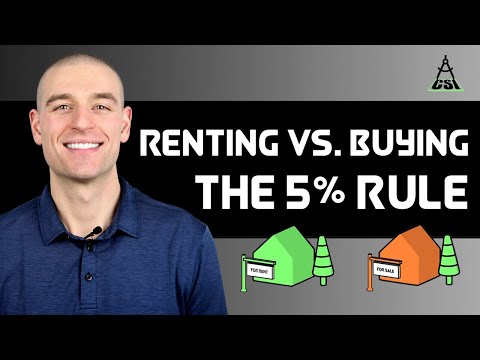
Ben Felix's 5% rule (a heuristic from his video "Renting vs. Buying a Home: The 5% Rule") puts owning's annual unrecoverable costs at about 5% of the home's value: roughly 1% property tax + 1% maintenance + 3% cost of capital.
Worked: a $500,000 home → dollars a month. If a comparable home rents for less, renting and investing the difference is financially competitive; if it rents for more, owning looks better.
Adjust each component for your market: US property tax runs from well under 1% to over 2% by state; older homes need more maintenance; the cost of capital rises with mortgage rates. Buying also carries transaction costs of several percent each way, so a short stay (under about five years) favors renting. Owning has real non-financial benefits (stability, control); price them honestly rather than calling a house "an investment".
Auto loans
Cars are depreciating assets, and longer loan terms keep payments low while pushing total cost up. Q2 2026 Fed data (G.19): new-car loans at finance companies averaged 67 months and $41,705 financed at 6.3%; commercial banks charged 6.97% on 72-month new-car loans.
$35,000 at 7% APR:
| Term | Monthly payment | Total interest |
|---|---|---|
| 36 months | $1,080.70 | $3,905 |
| 48 months | $838.12 | $5,230 |
| 60 months | $693.04 | $6,583 |
| 72 months | $596.72 | $7,964 |
| 84 months | $528.24 | $9,372 |
The term-length trap: the dealer asks "what monthly payment works for you?" and stretches the term to hit it. On a 72- or 84-month loan you are likely to owe more than the car is worth (negative equity) for years; trade it in early and the shortfall is rolled into the next loan.
- Negotiate the out-the-door price first, then financing, then any trade-in, as separate deals.
- Get pre-approved at a credit union or bank before the dealership; let the dealer beat it if they can.
- Decline add-ons (paint protection, VIN etching, many extended warranties). GAP insurance matters only if you have little equity; it is usually cheaper from your auto insurer.
- The 20/4/10 convention (see money basics): 20% down, ≤ 4 years, total car costs ≤ 10% of gross income.
Student loans
| Federal (Direct Loans) | Private | |
|---|---|---|
| rate | fixed, set by law each year | fixed or variable, based on credit (often a co-signer's) |
| income-driven repayment | yes | no |
| Public Service Loan Forgiveness | yes (qualifying plans and employers) | no |
| deferment, forbearance, death and disability discharge | yes | limited, lender-specific |
| bankruptcy | hard to discharge (undue hardship) | hard to discharge |
Federal student lending changed substantially under the One Big Beautiful Bill Act (signed July 2025), mostly from 1 July 2026. High level, as of September 2026:
- SAVE is over. A federal court entered judgment ending the SAVE plan in March 2026 under a settlement with Missouri and other states. Borrowers who were parked in SAVE forbearance are being sent notices (from July 2026) giving 90 days to choose a new plan, or they are placed in one.
- New repayment plans (from 1 July 2026): a new standard plan with fixed terms of 10–25 years depending on the balance, and the income-driven Repayment Assistance Plan (RAP): payments of 1–10% of adjusted gross income, minus $50 a month per dependant, minimum $10 a month, with unpaid interest waived, and forgiveness after 30 years (360 qualifying payments).
- Loans made on or after 1 July 2026 can use only the new standard plan or RAP. Existing borrowers keep access to the old standard, graduated and extended plans and IBR, and can opt into RAP; PAYE and ICR closed to new enrollment on 1 July 2026 and the remaining legacy income-driven plans other than IBR end on 1 July 2028.
- Borrowing limits: Grad PLUS ended for new borrowers; new caps for graduate ($20,500 a year, $100,000 total) and professional students ($50,000 a year, $200,000 total); Parent PLUS capped at $20,000 a year and $65,000 total per student.
Details are still moving; verify on StudentAid.gov (opens in a new tab) and with your servicer before acting. Principles that don't change: never refinance federal loans into private ones if you might need income-driven repayment or PSLF; borrow no more in total than your expected first-year salary as a rough ceiling; prefer federal over private loans.
Paying off debt: avalanche vs snowball
| Method | Order of extra payments | Pros | Cons |
|---|---|---|---|
| avalanche | highest interest rate first | least interest, fastest (mathematically optimal) | first win may take a long time |
| snowball | smallest balance first | quick wins; fewer accounts to track sooner | costs more interest |
| hybrid | clear one or two tiny balances, then avalanche | most of both | – |
Both: pay every minimum, put all extra money on the target debt, and when it is gone roll its payment into the next one (the total monthly budget stays fixed).
Worked comparison
Four debts, $27,000 in total, minimums $640, fixed budget $1,200 a month (simulated month by month):
| Debt | Balance | APR | Minimum |
|---|---|---|---|
| Card A | $9,000 | 24% | $180 |
| Card B | $2,000 | 18% | $40 |
| Car loan | $12,000 | 7% | $300 |
| Personal loan | $4,000 | 12% | $120 |
| Avalanche | Snowball | |
|---|---|---|
| payoff order (month cleared) | Card A (15), Card B (17), personal (20), car (26) | Card B (4), personal (9), Card A (21), car (27) |
| debt-free | month 26 | month 27 |
| total interest | $3,740 | $4,327 |
| first account closed | month 15 | month 4 |
Avalanche saves $587 and a month here. The gap grows with bigger APR differences and bigger balances in the high-rate debt.
The evidence on motivation
- Gal and McShane (2012), using data from a debt-settlement program: closing individual accounts predicted eventually eliminating all debt, regardless of the dollar size of those accounts, which suggests small wins sustain effort (Journal of Marketing Research).
- Amar et al. (2011): in experiments, people preferred to pay off small debts first even when that cost more ("debt account aversion") (Journal of Marketing Research).
- Kettle et al. (2016): concentrating repayments on one account increased motivation and progress (Journal of Consumer Research).
Reading: avalanche is optimal if you stick with it. If you have abandoned debt plans before, the snowball's extra cost is cheap insurance. Either beats minimum payments by a mile.
Consolidation and refinancing
| Option | Idea | Watch out for |
|---|---|---|
| 0% balance-transfer card | pay no interest for 12–21 months for a fee | fee; the promo ends; needs good credit; don't respend on the old card |
| personal loan | fixed rate and term to replace card debt (24-month personal loans averaged 11.86% at banks, Q2 2026 G.19) | origination fees; only helps if you stop using the cards |
| HELOC or cash-out refinance | cheap, secured by your home | turns unsecured card debt into debt that can cost you the house |
| 401(k) loan | borrow from yourself | lost growth; if you leave the job it may be due quickly or taxed as a distribution |
| debt management plan | a nonprofit credit counsellor negotiates lower rates; you make one payment | cards are usually closed; takes 3–5 years; pick an accredited nonprofit |
| debt settlement | a company negotiates paying less than owed | fees, deliberate missed payments, severe credit damage, forgiven debt may be taxable income; a last resort before bankruptcy |
Consolidation doesn't reduce debt; it reduces the rate. It fails if spending continues. Cut the cause first.
Good debt vs bad debt
Heuristics, not laws:
| Tends to be reasonable | Tends to be harmful |
|---|---|
| a mortgage you can afford at 28/36, on a home you'll keep for years | any credit-card balance carried month to month |
| federal student loans for a degree with a clear earnings payoff, borrowed modestly | payday loans (APRs often in the hundreds of percent), title loans, rent-to-own |
| low-rate, short-term financing on a necessary, reliable car | long auto loans on new cars you can't afford in cash-plus-short-loan |
| business debt with a clear return | BNPL for everyday spending |
| 0% financing you will clear inside the promo, with cash already set aside | borrowing to invest in speculative assets |
Tests: Does it buy something that appreciates or raises income? Is the rate lower than a realistic return on the alternative? Could you still make the payment on 80% of your income? Is the payment fixed and the term short? The more "no" answers, the worse the debt.
Debt collection rights
The Fair Debt Collection Practices Act (FDCPA) and the CFPB's Regulation F (in force since November 2021) govern third-party debt collectors (generally not the original lender).
| Right | Detail |
|---|---|
| validation notice | within 5 days of first contact the collector must send the amount, the creditor, an itemisation and how to dispute |
| 30-day dispute window | dispute in writing within the validation period and collection must pause until they verify the debt |
| call limits | presumed violation to call more than 7 times in 7 days about a debt, or within 7 days after a phone conversation about it |
| times and places | no calls before 8 a.m. or after 9 p.m. your time; not at work if you say your employer forbids it |
| stop contact | ask in writing and they must stop, except to confirm or notify of specific actions (such as a lawsuit) |
| no harassment or lies | no threats, abusive language, false claims of arrest or legal action, or pretending to be a lawyer or government |
| time-barred debt | a collector may not sue or threaten to sue on debt past the statute of limitations; a payment may restart the clock in some states |
What to do: never ignore a lawsuit (a default judgment can lead to wage garnishment); dispute in writing; keep records; don't give bank access or pay by phone to an unverified caller ("phantom debt" scams); report violations to the CFPB and your state attorney general. You can sue a collector for violations.
Bankruptcy in brief
| Chapter 7 ("liquidation") | Chapter 13 ("wage earner's plan") | |
|---|---|---|
| who | passes the means test (income below the state median, or too little disposable income) | regular income; debts under the statutory limits |
| how | a trustee sells non-exempt assets; most unsecured debts discharged within months | a 3–5 year repayment plan from disposable income; keep assets |
| good for | low income, few assets, overwhelming unsecured debt | stopping foreclosure and catching up arrears, protecting non-exempt assets |
| credit report | up to 10 years | up to 10 years allowed; usually removed after 7 |
Usually not dischargeable: most taxes, child support and alimony, most student loans (only with "undue hardship" proved in a separate proceeding), criminal fines, debts from fraud. You must take credit counseling from an approved agency before filing and a debtor education course before discharge. See a bankruptcy attorney; many offer free consultations. Bankruptcy is a legal tool, not a moral failure, but it is expensive in credit terms: use it when the debt truly can't be paid, not to avoid a hard few years.
Buy now, pay later (BNPL)
Pay-in-4 BNPL splits a purchase into four payments over about six weeks, usually interest-free; longer BNPL plans charge interest like any installment loan.
| Risk | Why |
|---|---|
| loan stacking | several plans across several providers are easy to lose track of; no single view of what you owe |
| overdrafts | autopay pulls from a debit card or checking account on fixed dates |
| late fees and collections | missed payments can go to collections and damage credit |
| thin protections | the CFPB's 2024 interpretive rule treating BNPL like credit cards for dispute rights was withdrawn in May 2025; returns and disputes run through the provider's own process |
| credit reporting inconsistency | reporting to bureaus varies by provider; FICO announced score versions that incorporate BNPL data in 2025 |
| spending more | splitting a price makes it feel smaller and easier to overspend |
Rule: use BNPL only for a purchase you could pay for in full today, with a credit card as the better alternative (better dispute rights, one statement). Never use it for groceries or bills; that is a sign of a cash-flow crisis, not a payment preference.
Checklist
CREDIT HEALTH (every few months)
[ ] Pull all three reports free at AnnualCreditReport.com
[ ] Dispute errors with bureau AND furnisher, in writing
[ ] Credit frozen at Equifax, Experian, TransUnion (free);
    thaw only to apply
[ ] Every card on autopay for the STATEMENT BALANCE
[ ] Reported utilization low before any big application
[ ] Keep oldest no-fee card open and lightly used

BEFORE BORROWING
[ ] Is this purchase necessary, and could I wait and save?
[ ] APR, fees and total cost of the loan written down
[ ] Payment affordable on 80% of income?
[ ] Rate-shop within 14 days; get pre-approval first
[ ] Shortest term I can afford; no add-ons
[ ] Mortgage: 28/36 check, 3+ Loan Estimates, points
    break-even, PMI removal date, rent-vs-buy (5% rule)

GETTING OUT OF DEBT
[ ] List every debt: balance, APR, minimum, due date
[ ] Stop adding to it (cards out of wallets and apps)
[ ] Starter buffer so surprises don't go on a card
[ ] Choose avalanche (cheapest) or snowball (motivation)
[ ] Automate minimums on all; extra on the target
[ ] Roll each freed payment into the next debt
[ ] Consider 0% transfer or cheaper consolidation loan
[ ] If hopeless: nonprofit credit counseling, then an
    attorney about bankruptcy, before debt settlement

COLLECTOR CONTACT
[ ] Ask for the validation notice; dispute in writing
    within 30 days
[ ] Never pay an unverified caller; never ignore a lawsuit
References
- AnnualCreditReport.com (opens in a new tab): the only federally authorized site for free credit reports
- FTC: You now have permanent access to free weekly credit reports (2023) (opens in a new tab)
- CFPB: How long does information stay on my credit report? (opens in a new tab): 7-year and 10-year limits
- CFPB: How do I dispute an error on my credit report? (opens in a new tab)
- CFPB: Medical information rule (Regulation V) (opens in a new tab): the 2025 rule later vacated
- myFICO: What's in my FICO Scores? (opens in a new tab): the 35/30/15/10/10 factor weights
- myFICO: How to rate shop and minimize the impact to your FICO Scores (opens in a new tab): 14- and 45-day windows
- FHFA: Credit scores (opens in a new tab): VantageScore 4.0 and FICO 10T for Fannie Mae and Freddie Mac loans
- Federal Reserve G.19 Consumer Credit (opens in a new tab): card, auto and personal-loan rates (Q2 2026)
- CFPB: When can I remove private mortgage insurance (PMI)? (opens in a new tab): the Homeowners Protection Act 80% and 78% rules
- CFPB: General QM loan definition final rule (opens in a new tab): replacing the 43% DTI cap with price-based thresholds
- CFPB: What is a qualified mortgage? (opens in a new tab)
- Ben Felix, Renting vs. Buying a Home: The 5% Rule (YouTube) (opens in a new tab): the unrecoverable-cost heuristic
- StudentAid.gov: One Big Beautiful Bill Act updates (opens in a new tab): official federal student loan changes
- Gal and McShane (2012), Can small victories help win the war? Evidence from consumer debt management (opens in a new tab), Journal of Marketing Research 49(4)
- Amar, Ariely, Ayal, Cryder and Rick (2011), Winning the battle but losing the war: the psychology of debt management (opens in a new tab), Journal of Marketing Research 48
- Kettle, Trudel, Blanchard and Häubl (2016), Repayment concentration and consumer motivation to get out of debt (opens in a new tab), Journal of Consumer Research 43(3)
- CFPB: Debt collection rule (Regulation F) explained (opens in a new tab): validation notices and call limits
- CFPB: Buy now, pay later products (opens in a new tab)
- US Courts: Bankruptcy basics (opens in a new tab): Chapters 7 and 13
- CFPB: Submit a complaint (opens in a new tab)